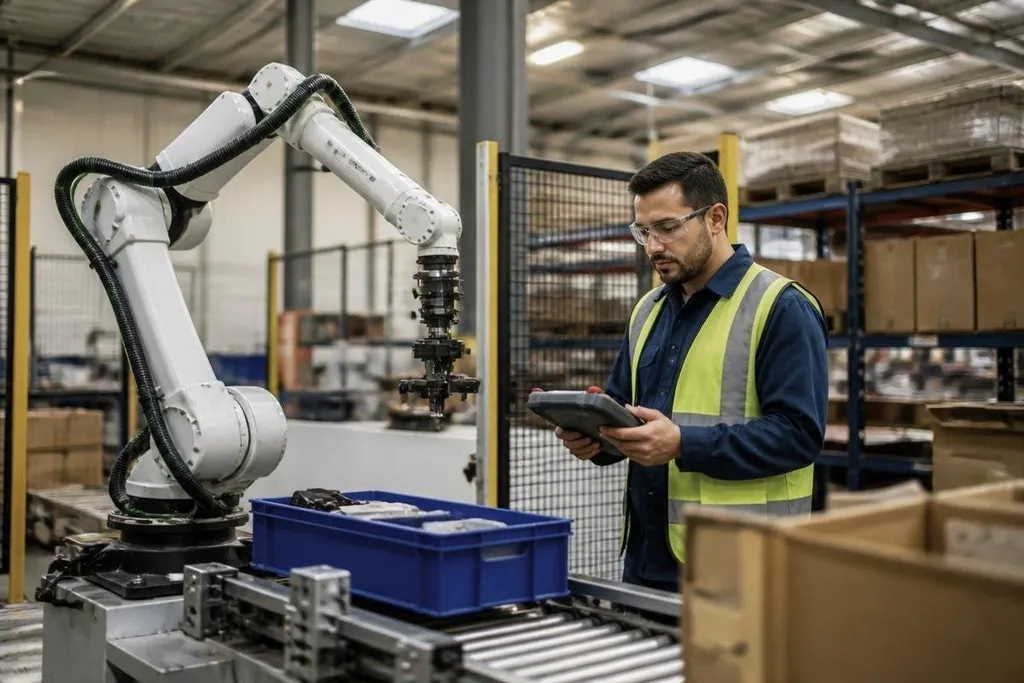
A six-axis robot arm can repeat the same motion for hours, while a technician still needs to set its limits, check its tools, and fix its faults. That split points to the main change robotics could bring to middle-class work: jobs may lose some tasks while gaining new technical duties.
- Repeatable work is easier to automate than work that needs judgment.
- Pay may shift toward setup, repair, safety, and process knowledge.
- Workers who learn to run automated equipment could have more options.
Robots change tasks before they erase jobs
Most workplaces are made of tasks, not single job titles. A warehouse worker may move boxes, scan labels, clear jams, and decide what to do when a package arrives damaged. A mobile robot can carry stock between locations, but it still needs people to handle exceptions and keep the work area safe.
That pattern matters for a technician deciding what to learn next. Automation may remove the repeated part of a role first, leaving more time for machine setup, fault checks, quality checks, and customer requests. The job changes before the job title does.
A robot arm shows the same split. Its six joints can follow a programmed path with steady timing, but someone must choose the gripper, set the payload limit, check the work area, and change the program when the product changes. Those duties need machine knowledge and knowledge of the process around it.
The new work sits close to the machine
Robotics can create demand for people who connect software, hardware, and daily operations. That work includes installing sensors, checking motor faults, editing a task sequence, and recording why a safety stop happened.
Some of the terms sound harder than they are. LiDAR measures distance with light, while a robot operating system such as ROS 2 helps separate software tasks into parts that can communicate. A worker doesn't need to become a software engineer to use those tools, but they do need enough training to spot a bad sensor reading or a failed network connection.
Pay could follow that shift because a stopped robot can interrupt the people and equipment around it. The open question is who gets the training. A company may train its current staff, hire outside technicians, or buy systems that require less local skill. Each choice changes who gains from the new equipment.
Training needs become easier to judge when you tie them to a real machine and workplace. Robot 24 covers those deployments, so you can see whether higher output creates paid technical work or leaves current staff with more duties.
Productivity gains won't reach everyone in the same way
A robot can help one worker handle more output, but the result depends on who owns the equipment and how the pay system works.
If a company keeps the savings, workers may see more pressure without higher pay. If workers gain training, better tools, or a share of the added output, the same machine could support a better job.
This is why the middle class question is also an ownership question. A small manufacturer that adds one robotic cell may need fewer people for loading parts, yet it may need more people who can program, inspect, and maintain that cell. The total headcount alone won't show who gained or lost bargaining power.
Robots also change the value of physical strength. A lift-assist system can reduce the force a person must apply to a heavy part, while a vision system can check measurements that are hard to inspect by eye. The worker still makes choices about the process, but the body carries less of the load.
What stays unproven
Robotics makers can show a machine completing a task under set conditions. That doesn't prove the system will handle damaged packaging, poor lighting, changing product sizes, or a crowded work area. Those cases cost time, and people usually handle them first.
I'd judge a robotics rollout by the training and job design around it, not by the robot count. A company that buys machines without giving workers time to learn them may get stalled projects and frustrated staff.
For a worker, the useful question is less about predicting one fixed job market. It is about finding which parts of the work are likely to remain human-led and learning the tools that support those parts.
A practical check before choosing a training path
Use these checks before spending money or time on a course:
- Name the task: Write down the repeated work in your current role and the exceptions that still need judgment.
- Watch the equipment: Find out whether local employers use robot arms, mobile robots, vision systems, or automated inspection.
- Learn fault checks: Pick training that covers sensors, safety stops, basic networks, and motor faults.
- Ask about access: Check whether the course gives you time on real equipment rather than slides alone.
- Check the job path: Look for roles such as robot technician, controls technician, field service technician, or automation operator.
- Measure the cost: Compare course fees and lost work time with the pay and duties listed in nearby job openings.
The middle class won't be reshaped by robots alone. It will depend on who controls the machines, who learns to keep them running, and whether the next job offers more pay for that added responsibility.